
Be My Guide
A productivity app for students that minimizes distractions from your phone, keeps you focused, and organizes your school assignments.


Heading into this project, I had the idea of making a planner app curated for students. My main goal was to not only create a digital planner, but an app that would help them cultivate better habits. As I did some market research and user research, those goals slightly shifted and became more refined into what is now the "Be My Guide" productivity and focus app.
Market Research - Phase 1
For this first phase of research I had 3 goals in mind:
-
Determine how affective planners are for students.
-
Understand the pros and cons of physical planners versus digital planners.
-
Perform competitive analysis of current planner apps.
From my extensive research I determined 4 key insights:
-
In general, the benefits of having a planner are as follows: improving time management, increasing productivity, developing responsibility.
-
Having a planner is not a guarantee of productivity, as follow-through is the main part of maintaining habits that requires a lot of effort, time, and resources, which is what leads people to fail.
-
Though both are good, the benefits of a physical planner outweigh the digital version.
-
There are a multitude apps that are good at listing and reminding of you tasks, but besides calendar integration, there are little-to-no habit-building features.
User Research
Due to time constraints and limited resources, my user research is not as extensive as I would like it to be. However, what user research I did perform did offer a lot of insight.
Main User Research Goals:
-
To understand how students try to stay productive and on task.
-
How students undertake organizing and scheduling their assignments.
-
To understand sources of distraction of students and how and if they combat them.
I ran a survey targeted towards college students, a majority of which were graduate students or senior undergraduate students. I surveyed 18 students in total.
Key Survey Insights
44%
of students
71%
of students
4/18
students
14/18
students
Said that their phone was their primary source of distraction while studying or doing their homework.
that recorded that they used a planner, calendar, or other aid to keep track of their assignments, stated that they were at least, "moderately productive" as a result of having it.
Recorded that they did not have a planner or calendar to keep track of their assignments. They reported only having either "not enough time" or "barely enough time" to finish their assignments.
that reported to using a planner or calendar to keep track of assignments reported that they either had "barely enough time" or "just enough time" to finish their assignments.
Market Research - Phase 2
Based on those survey results, my interest shifted from making a planner app, to seeing if there was another way to improve productivity and minimize distractions from your phone. I decided to some some more market research with these goals in mind:
-
To Understand the science behind attention, focus, and distractions. Particularly the caues, of distraction and methods to eliminate distraction and increase attention.
-
To understand the science of breaking bad habits and building new ones.
From my research I came with these key insights:
-
Orienting your attention to a task/activity spends mental resources, so whenever a distraction takes away your attention, you have to spend additional energy to reorient yourself to the task at hand.
-
Attention switching isn't always bad if you come to a natural stopping point in your task and are doing so to recharge mentally.
-
Habits are actions that are instinctual because they are cued by external contextual factors rather than internal motivation. So the best way to build a habit is to repeat an action within the same context every time.
-
People's self-awareness and ability to self-regulate their mental energy varies, so knowing what would be most effective for building healthy study habits varies according to the individual.
Final Design Goals
1. Eliminate distraction by discouraging phone use.
2. Make building a habit as seamless as possible.
3. Provide a platform where students can organize and breakdown their assignments.
I cannot control the external environment of the user, nor can I force them to make decisions that they do not want to make. So I chose to specifically target the issue of distraction and focus for "Be My Guide."
There were 3 main user flows that I was determined to create for Be My Guide that would tackle those main design goals:
Flow One: Starting and completing a timed study session, which would lead to a short evaluation, then to a break timer.
Flow Two: Inputting, organizing, and breaking down assignments into smaller components to complete over time.
Flow Three: Setting up regular reminders with varying levels of intensity and invasiveness depending on the needs of the user.
Due to time constraints, I chose to focus on the first one.
The Design
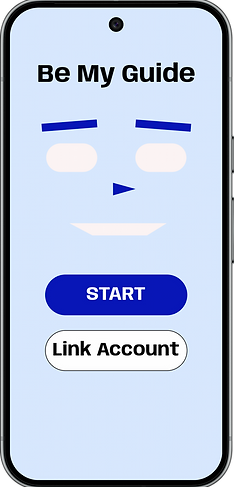


I designed a mid-fidelity prototype that would allow users to create timed study and break sessions that they can modify to a pattern that best fits them. Once you enter study mode, your "guide" will hold you accountable. If you try to navigate away from the screen or end the the session early, the guide will make sure you are certain you want to leave. The point is to add points of friction between the user and any phone use during a study session.
The colors I chose were simple, blue to promote focus and green for the break timer to promote relaxation.
Prototype

Ending Study Session Early
Normal Study Session Completion
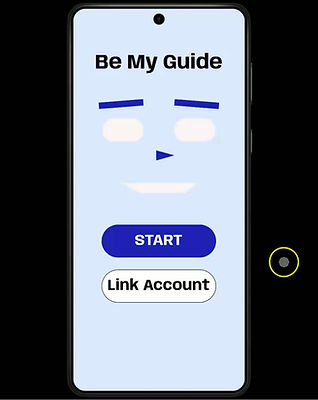
I created a simplified version of the guide that would be with you during the study and break sessions to encourage you throughout the process and discourage you from quitting too early.
The first prototype depicts what happens when you quit a session before the time runs out and the second one shows what happens when you complete a study session.
After the study session ends, whether through completion or ending it early, the user will be prompted to compete a short evaluation if they so choose. The purpose is to get the user to think about their work session to see if they need to adjust. If you lose focus during the session than you might need to have a shorter session or incorporate a longer break time. The goal is to encourage the user to understand what conditions work best for them so they can better practice the habit.
Conclusions & Takeaways
I enjoyed this project and really vibe with the concept. I think the biggest constraint I faced was the limited time frame to engage in the user interviews and user testing as well as in building out the design to its completion in a high-fidelity prototype.
For the user interviews, I would have liked to get into the specifics of student habits and practices while studying. The specific context behind their distractions and whether or not they had strategies to deal with it would be really helpful to know.
I created a mid-fidelity prototype with a very simple mascot for my "guide". If I had the time and the know-how, I would refine the design, create more robust animations, and have it be more expressive. (Think the Duolingo owl, but maybe not as pushy).
In addition, I would build out the other flows I mentioned as well.